

Blog
Why No Two Look Alike

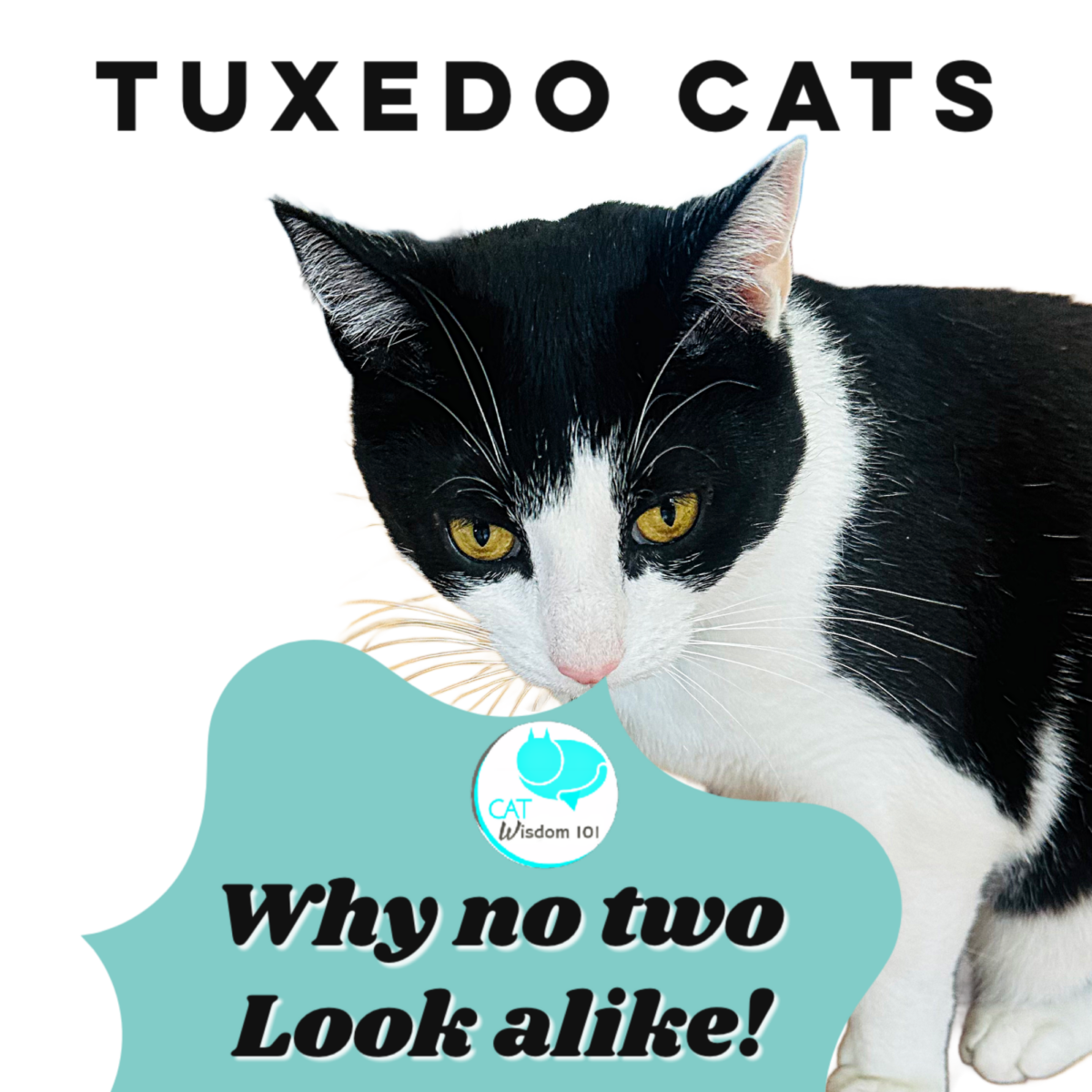
Why No Two Tuxedo Cats Look Alike (And the Science Behind It). My very different Tuxies, Otto and Lumi, serve as purrfect examples.

I’ve been writing about cats at this blog for sixteen years. I’ve shared countless photos of my cats, celebrated their personalities, and documented their many opinions about everything. But somehow I never stopped to write about something I look at every single day: the fact that my two tuxedo cats look almost nothing alike.
No two Tuxedo cats are identical. They are as unique as a fingerprint.

Otto has the classic tuxedo: crisp, symmetrical black and white, like he’s always ready for a black tie event. He’s a big guy, black-nosed, green-eyed with a confident swagger, fully aware how handsome he is.

Lumi is half his size, has been with us only a few months, and has already established beyond any doubt that she has Otto under her dainty paw.

Her markings are irregular and asymmetrical strange, beautiful splashes of white on black with a pink nose, a mostly white face, and the confidence of someone who has never once questioned her own authority.
At age 5, she is still impossibly kittenish cute which she uses to her advantage. Neither cat is too proud to beg for treats or cuddles.

Same category. Completely different cats. Which finally made me ask: why?
First: Tuxedo Isn’t a Breed
Tuxedo refers to a coat pattern, not a breed. Any cat, domestic shorthair, Maine Coon, Norwegian Forest Cat can wear a tuxedo. What they share is a bicolor coat: black with white, distributed in a way that vaguely suggests formal wear.
Both Otto and Lumi are shorthairs, though longhaired tuxedos absolutely exist and are just as elegant as their shorthaired counterparts. Beyond the basic pattern, the variation is enormous and the science behind it is genuinely interesting.

The White Spotting Gene
The key is something called the white spotting gene, often noted as the S gene (or KIT gene). This gene controls whether and how much white appears in a cat’s coat by affecting the migration of pigment-producing cells called melanocytes during fetal development.
Melanocytes originate near the spine and migrate outward toward the skin as the embryo develops. Where they successfully arrive, you get color. Where they don’t make it in time, you get white.

A cat with low-grade white spotting may end up with just a white chest patch or a few white toes. A cat with higher expression ends up with large irregular white patches, a white belly, a white blaze or in Lumi’s case, markings that look like abstract art made very deliberate choices.

The degree and pattern of white is influenced by how many copies of the gene a cat carries, modifier genes that affect how far melanocytes travel, and fascinatingly, a genuine element of developmental chance.
Even genetically identical cats can have different spotting patterns, because the migration process is not perfectly reproducible. This is partly why tuxedo patterns can’t be predicted with precision. They’re the result of a biological process that plays out differently every time.
Why Lumi Has a Pink Nose and Auto Has a Black One

Nose leather follows the same logic as the coat. A black nose means melanocytes successfully colonized that tissue. A pink nose means they didn’t. Cats with more white on their faces like Lumi are more likely to have pink or parti-colored noses. Cats with minimal facial white like Otto tend to have fully pigmented black noses. Same gene, different outcomes, written right there on their faces.
Symmetry vs. Asymmetry

Otto’s balanced, symmetrical markings versus Lumi’s irregular pattern comes back to that same developmental migration. When melanocytes travel evenly on both sides of the body, you get symmetry. When the migration is uneven which happens more often than not you get the asymmetrical, one-of-a-kind markings that make each tuxedo cat unmistakably themselves.
Interestingly, highly symmetrical patterns like Otto’s are actually somewhat less common. Most tuxedo cats, if you look carefully, have at least some asymmetry. He just happened to come out balanced.
Those Eyes

Otto has what I call gooseberry eyes, a lovely green but Lumi has golden amber eyes, which is probably the most common eye color in tuxedo cats and in domestic shorthairs generally. Eye color in cats is determined by melanin concentration in the iris: gold and amber reflect moderate to high melanin levels.
Blue eyes in cats are typically linked either to the pointing gene (as in Siamese) or to very high white spotting near the face, where reduced melanin affects the iris as well.
Since most tuxedo cats have moderate white spotting that doesn’t dominate the face, blue eyes are uncommon in the pattern. Green appears occasionally. Gold is the default, and honestly it suits cats perfectly.

Toe Beans: Pink, Black, or Both
Read our post All About Cat Pads
The same white spotting logic that governs coat, nose, and eye color also governs paw pads, what the internet has affectionately named toe beans. White paws generally mean pink pads. Dark-furred paws generally mean dark pigmented pads.

Cats with mixed coloring on their feet often have parti-colored pads, part pink and part black, sometimes in patterns that look almost intentional. It’s worth a close inspection if you haven’t checked lately. Consider it homework.

The Whisker Surprise
Read our post Whisker Secrets of Cats
Here’s something I never thought about until I actually sat and stared at my cats recently: Auto has a black face and white whiskers. Lumi has a white face and white whiskers. Same result, apparently different logic.
It turns out that whiskers, technically called vibrissae, develop from follicles that are largely unreceptive to melanocyte colonization, regardless of what color the surrounding fur is. This is why the vast majority of cats, including many fully black cats, have white whiskers.
Lumi’s make intuitive visual sense. Otto’s are the more interesting case, and the more biologically revealing one: the whisker follicle is simply doing its own thing, independent of the coat around it. A cat with black whiskers is actually the exception worth noting.

Two Cats, One Pattern, Infinite Variation
What I find most beautiful about all of this is that both cats are expressing the same underlying genetic mechanism and yet they ended up completely, unmistakably themselves. Otto, large and in charge (in his dreams!) is a big boy, symmetrical but Lumi, half his size, irregularly marked, pink-nosed, is already running the household.
Sixteen years of writing about cats, and they’re still teaching me something new every day!
Do you have anything you’d like a share about Tuxedo cats?
You may also enjoy learning more about Tuxies National Tuxedo Cat Day Celebration